

Susan Dennard's writing process shook me to the core
Learning to write novels goes hand in hand with getting to know yourself. At first, all writing advice is equally plausible if you have no clue what kind of writer you are. But as the time goes on...

This post is a scramble of spontaneous thoughts that I had after reading Susan Dennard’s latest Substack post. You can find it here.
She writes how her writing process evolved over the years and how important it is to ignore certain writing advice and find what works for you. In this post I’d like to share which bits resonated with me, and which made me shudder in cold sweat1.
Before we continue, I need to put a small asterisk. Susan Dennard is an established YA author who published and sold plenty of books already, whereas I am a small daydreaming wannabe. Therefore, her thoughts on writing process carry a bit more weight than mine. Imagine an elephant looking down on a mouse, with the mouse going “well, actually...”. That’s what’s happening here. I’m the mouse—just so you know where we stand here.
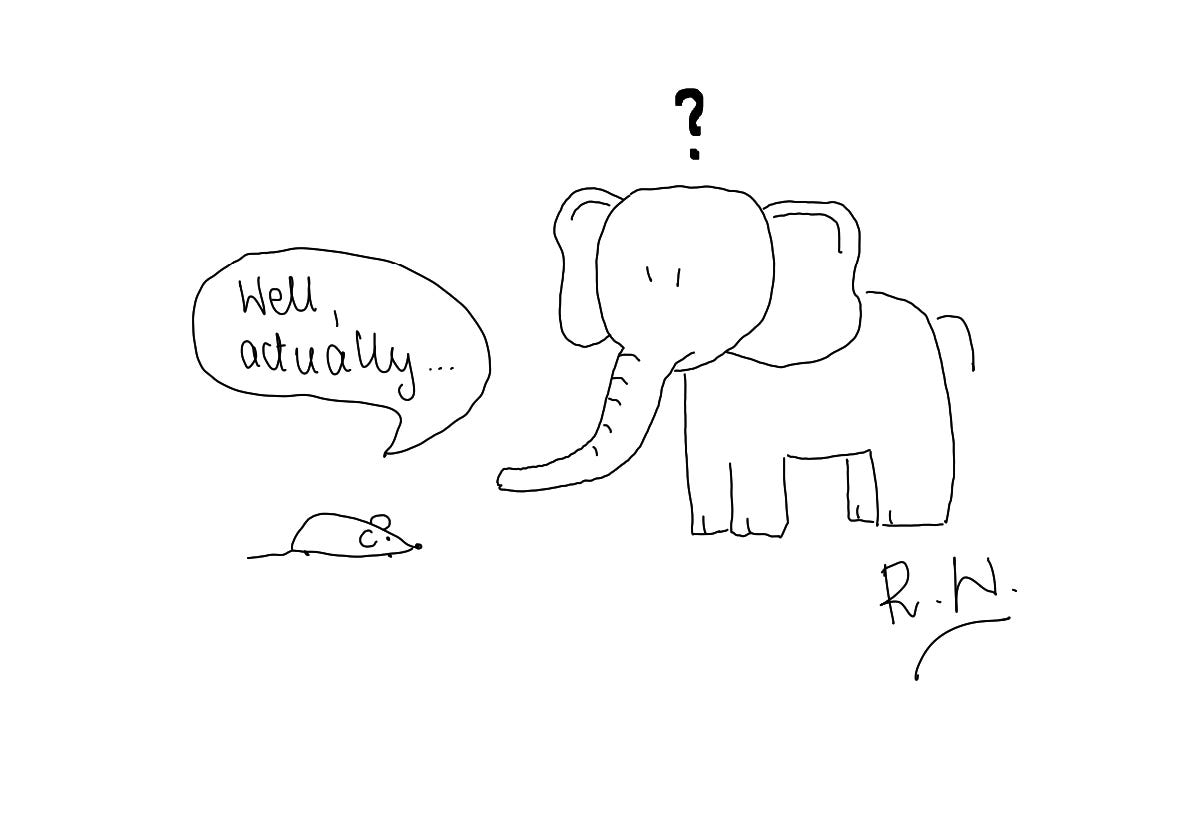
Then again, I don’t disagree with the overall premise of her post at all.
What works for her in regard to writing is: destinations not goals. Before she figured this out, if her goal was to finish book A till the end of year, she’d not let herself get distracted by a sudden impulse to write book B. She’d try to stick to book A no matter what, making herself somewhat miserable in the process. Her current solution for this conundrum is allowing herself to write multiple books at once, jumping between one and the other, depending on the mood. As long as writing gets done and either book gets finished in that year, all is fine.
Overall, I couldn’t agree more—if this process works for her, that’s great. Learning to write novels oftentimes goes hand in hand with getting to know yourself. At first, all writing advice is equally plausible if you have no clue what kind of writer you are. Unfortunately, that can make things confusing, since a lot of the advice is simply contradictory—which does not mean any piece of advice is inherently wrong. Different people need different things. The more creative projects you bring to an end, the more you discover which type of artist you are. Getting to know yourself allows you to sift through all the available pieces of advice; figuring out what to try and what to discard at once is incredibly useful.
For example, if I struggled with a certain part of my novel and received the advice “just work on another project”, I would shoot myself in the knee trying to follow it. The fact that Susan Dennard can work on multiple books at once makes my head explode. The idea of sitting down to write and having to decide which book to tackle feels like a horror story to me. I can barely hold one original story in my head; trying to toggle three would most definitely lead to breakdown, burnout, and head-banging my desk.
Admittedly, at the end of previous year, I felt an itch to pause the work on my novel in favor of writing a little fanfic. After considering it for a while, I decided to go for it. However, the switch I made was total: I did not open the Scrivener project with my novel until I was done with the fanfic. And when it was posted, I shook off the fanfic vibes completely and went back to my novel full-time once again. I cannot imagine working on two—much less three or more—writing projects simultaneously.
Since she finished plenty of books jumping like that, it means this process, which makes me break out in cold sweat, is working for her. It would most definitely not work for me—but I know myself well enough to realize this. If you don’t, feel free to give her approach a go. Simply beware that what works amazingly for one writer can be an absolute disaster for another.
I would venture a guess that her approach can only work for writers with well-established writing routines. If you are disciplined enough that you sit down to write three times a week no matter what, it won’t be detrimental to work on multiple projects at once—as long as you hold yourself accountable to finish certain number of them in a reasonable timeframe. In other words, as long as projects get finished (and not just started), you are good.
On the other hand, if you keep starting new projects, yet nothing ever gets through the finishing line, you might benefit from asking yourself some tough questions. Is this truly a valid creative process, or maybe just a burst of short-lived enthusiasm? In the end, only the results will tell, but I believe that your gut will provide hints whether you are on the right path.
Have you ever heard of creative process that is so different from your own that the sheer thought made you recoil?2
Stay focused on your art,
Robin W.
Post Scriptum
I have to admit, I haven’t actually read any of Susan Dennard’s books yet. I am thinking of giving “The Executioners Three” a go. At the same time, I slowly develop a hunch that as a reader, I tend to prefer books by writers who have a similar writing process to mine. Reading this book will probably be a good way to start testing this theory.
Also, June was surprisingly productive when it comes to my novel writing. Not only have I managed to finish chapter 15, I also managed to continue writing past that. While chapter 16 has not yet been started, I have added a lot of smaller scenes into the earlier parts of the book, so now I’ve got a lot of chapters with weird numbering like “Chapter 3.5”. The decimals will get corrected in the revisions; I don’t care for now ;)
which is incredibly useful in the current heatwave, so thank you, Susan
Internally, I hope, since there are no inherently good or bad processes, only those that work and those that do not.