

A few noteworthy things from June '25
Searching for new things via search bar of anything brings fewer and fewer satisfying results. With that in mind, I’ve decided to share some cool things I've come across in the previous month.

In the times of internet being taken over by the piles of AI slop, we need to defend ourselves. Searching for new cool things via search bar of anything (Google, Pinterest, Instagram, YouTube, Substack) brings fewer and fewer satisfying results. With that in mind, I’ve decided to start sharing a few cool things that I’ve seen, watched, read, or just generally came across in the previous month.
Another reason for this list is to force me to interact with things in a more mindful manner.
So here are a few noteworthy things I’ve come across last month:
Last Week Tonight’s Episode on AI slop
Source:
This is partially the reason for me sharing this list, though of course such lists are a common practice among the newsletter-writers.
I generally watch John Oliver’s “Last Week Tonight” almost religiously — I think I have actually seen all the episodes posted on their YouTube channel, and some more than once — but many episodes talk about mostly US-problems. This one, however, sheds some light on a broader problem, and one that all avid internet users start to notice nowadays: the overwhelming rise of AI slop.
I can personally confirm that part about Pinterest having turned into a pile of AI crap. I sometimes, though not that frequently, use this platform to make mood boards for scenes in my novel that are more difficult for me to write. But when I recently tried to find some inspiration there, I was completely flooded by AI “enhanced” digital art. In the thirty or so minutes I’ve spent browsing Pinterest, I have not come across a single image that was not marked as “AI enhanced”.
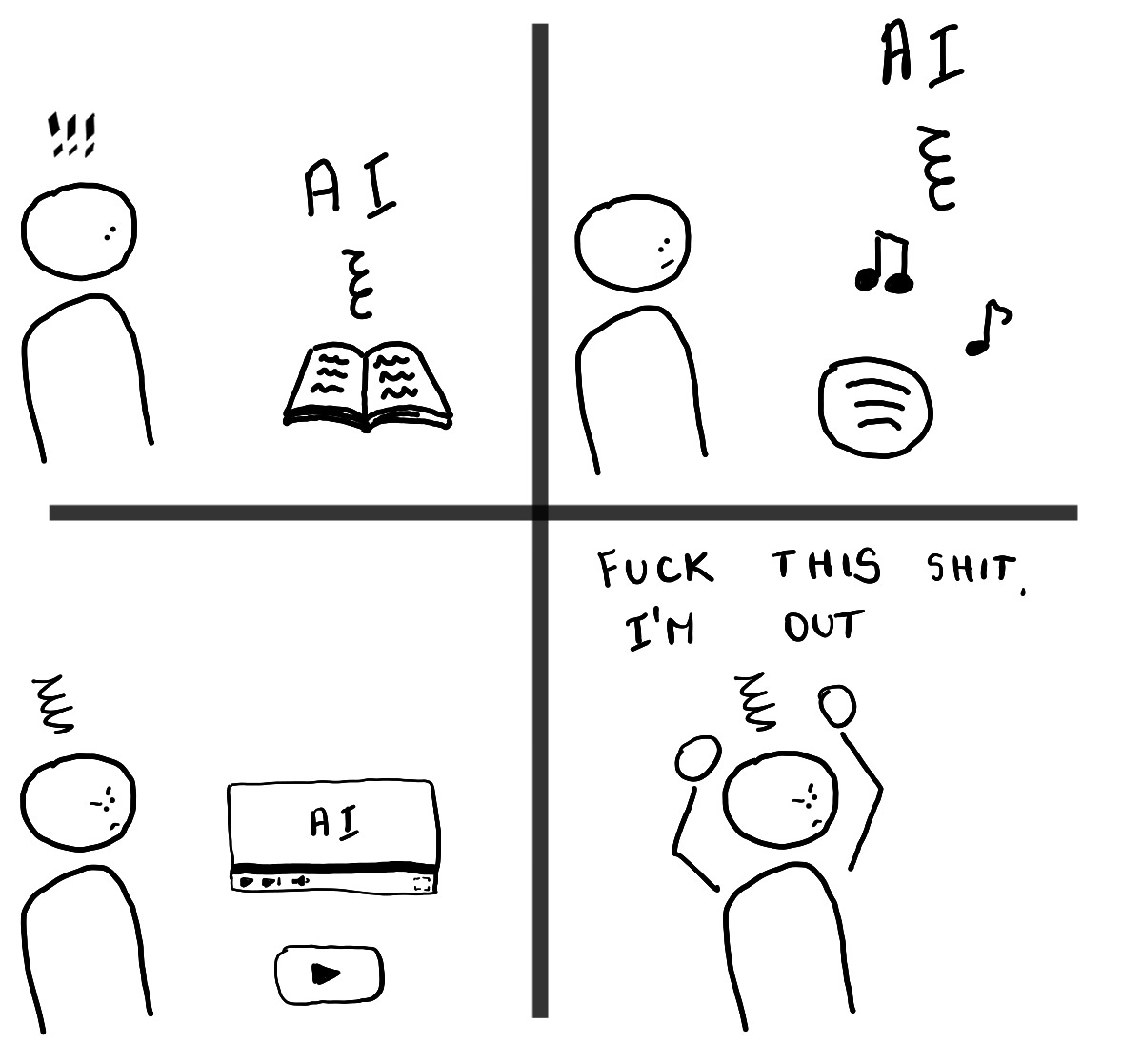
I find it disturbing. What is worse, there doesn’t seem to be a way to filter those out. Great job, Pinterest. Seems I need to find another platform to look for digital art to use as writing inspiration — I am extremely open for recommendations in that regard.
Anyway, this episode of Last Week Tonight goes more in depth about why do we suddenly see so much of AI generated content everywhere. And why it’s a problem.
“Solo Leveling” Manhwa (Webcomic)
I have watched the released anime episodes as soon as they were out, but I felt the need to scratch that itch for more, so I have reached for the webcomic. And I gotta say, I did not expect the plot to keep being so gripping all the way till the end ( I have read some information just now that the story is not, in fact, finished yet; it felt pretty ‘finished’ to me, though). Additionally, what speaks for the quality of this story is that even though I know the ending, I still can’t wait to watch it on screen.
It’s funny. It seems that after having taken a long break from watching anime (as in: anime in general), I am having some kind of anime-interest renaissance nowadays. For instance, in the past months I have also watched “The Eminence in Shadow” and “Frieren: Beyond Journey’s End”. The first one is good and entertaining, but the second one… the second one really stays with you.
“Glucose Revolution”, book by Jessie Inchauspé (“Der Glukose-Trick”)
Recently I have been trying to lose some weight, as one does. While I am taking a gentle approach based on portion control, eating more vegetables and avoiding liquid calories (basically: water instead of soda), and not on attempting to revolutionize my life by religiously following some new hot diet, it is definitely the case that the matter of healthy eating is on my mind more than usual. So when I accidentally stumbled upon this book, I got curious and honestly — it will definitely leave its mark on how I eat.
The entire premise of the book is as follows: avoiding rapid blood sugar fluctuations is beneficial even to those people who don’t suffer from diabetes. The first part of the book explains various forms that sugar can take (glucose, fructose, saccharose) and their influence on our bodies, the second part talks about the impact of blood sugar spikes on our life (briefly: it can make you “hangry” and it can make your sugar cravings worse), and the last part gives you tricks on how to keep your glucose curve flat.
I tend to be wary of books that take one aspect of a complex matter and then attempt to convince you that this one thing is responsible for all your issues, from migraines to cancer; follow the advice and all your life’s problems will be solved. On the other hand, one factor can indeed often influence a plethora of others — I am very much able to believe that if you, for instance, don’t sleep long enough or well enough for a period of time, there will be an entire phone book of medical conditions that show up purely because of that.
Whether blood sugar is such matter… Well, I would give that book the benefit of the doubt. I did recognize many symptoms named in there from my own experience, especially the tendency to get extremely hangry or even woozy when the last meal was too long ago. Meanwhile, my partner can be hungry and at the same time just patiently wait for the next meal. I hardly knew one could do that before I met him.
So honestly, while the trick with drinking vinegar had me immediately go “over my cold dead body!”, I think I will keep many others in mind. For instance, after reading this book, I definitely try to eat sweets as a dessert — i.e. after a proper meal — rather than as a snack, i.e. on an empty stomach.
Video by Kasia Gandor on the effects of phone screentime
Source:
Kasia Gandor is a well-known Polish YouTuber, one from the more reasonable and science-based end of the YouTube spectrum. She often picks an interesting question and does a deep dive into the current state of scientific research on that matter. Afterwards, she presents her findings in a form of a concise and easy-to-digest video essay.
This time, the topic stemmed from her own observations into how much time she spends per day looking into her phone screen. She asked among her followers how it looks for them, gathered plenty of responses, and concluded that it’s a darn big problem.
She dug into two aspects: how phone usage influences attention span, and how it influences our emotional well-being.
Interestingly, while there seems to be many quite conclusive studies confirming the detrimental effects of smartphone usage on attention span*, studies on the emotional aspect tend to show mixed results. Kasia Gandor explains why that might be — and that is honestly the part that makes the video so interesting for me. Using a spot-on visual example, she makes it clear why doing science is hard when it comes to such a complex matter as one’s emotional state. So one should not just take the “mixed results” at face value and go “oh, I guess smartphones are not as bad for our emotional well-being as some thought”, but rather understand that the question of smartphone’s impact on attention span is simply much easier to answer in a scientific manner than the question regarding emotions.
Good science, just as writing, is hard. (See how I didn’t write '“good writing”? That’s cause any writing is hard, even the bad one. Unless you AI it, in which case you’re weak).
*I think I may actually put the book “Attention Span” by Gloria Mark, which was referenced in this video, on my reading list
The video is in Polish, and if you happen to speak it, I recommend it a lot. (And if you don’t, consider your life choices and do better.)
And what interesting thing have you read, watched, or listened to in the previous month? Care to share in the comments or per email?
Stay focused on your art,
Robin Wren